
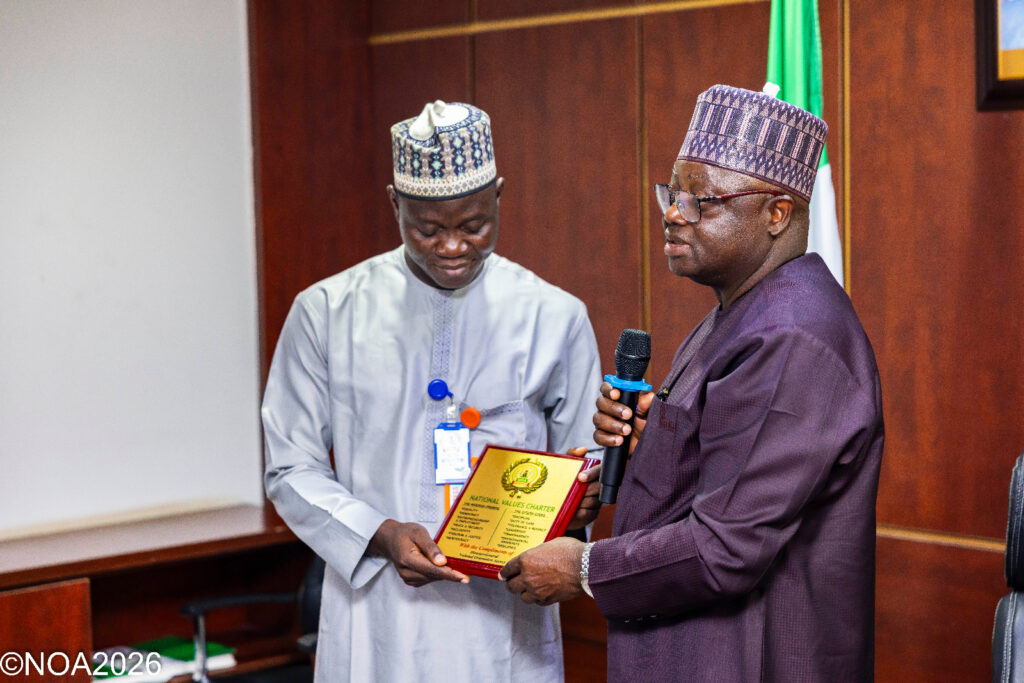
- NOA Pledges Nationwide Support Network for Investigative Journalists
The National Orientation Agency (NOA) and the Nigerian Guild of Investigative Journalists (NGIJ) have begun moves toward a structured partnership aimed at strengthening investigative journalism, combating misinformation, and deepening civic education across Nigeria.
This development followed a courtesy visit by the NGIJ delegation to the Director-General of NOA, Lanre Issa-Onilu, at the agency’s headquarters in Abuja.
Leading the delegation, NGIJ National President, Mallam Abdulrahman Aliagan, said the visit was designed to establish a long-term institutional relationship between both bodies in the interest of national development, accountability, and democratic consolidation.
In his address, Aliagan emphasized that investigative journalism exists to strengthen institutions rather than undermine them.
“Investigative journalism is not anti-government; it is pro-accountability, pro-transparency, and pro-citizen. It exists to strengthen institutions by helping them live up to their mandates.”
He noted that the mandates of NGIJ and NOA naturally complement each other. While NOA is responsible for civic education, public enlightenment, and value re-orientation, investigative journalism provides verified facts and evidence that enable citizens to understand how institutions function in practice.
According to him, democracy thrives only when citizens have access to credible information and when public power is subjected to scrutiny in the public interest.
Aliagan warned that misinformation, civic apathy, social tension, and declining public trust in institutions pose serious challenges to Nigeria’s democratic journey.
“Values without facts can be manipulated, and facts without values can be misunderstood. When orientation and truth walk together, they produce informed, responsible and engaged citizens.”
He proposed practical areas of collaboration, including joint public enlightenment campaigns on electoral integrity, anti-corruption, peace-building and social values; capacity-building initiatives on fact-checking and countering disinformation; and platforms for constructive civic engagement.
The NGIJ president also called for institutional support to safeguard ethical journalism, access to information, and an enabling environment where investigative reports are seen as tools for civic education rather than adversarial attacks.
“When investigative reports are treated as tools for civic education rather than as adversarial attacks, they strengthen the state and deepen democratic culture.”
Responding, Issa-Onilu lamented what he described as the steady decline of investigative journalism in Nigeria, saying the profession has lost depth, rigour, and commitment to factual accuracy.
“Investigative journalism, I would say, is almost practically dead in this country.”
He described the current media landscape as increasingly superficial, noting that journalism today often lacks interpretation, context, and thorough fact-checking.
“We are so much in a hurry now that we don’t give the necessary attention to facts. And facts, they say, are sacred.”
According to him, the erosion of investigative depth has contributed to misinformation, division, and poor civic understanding, particularly around governance and electoral processes.
He stressed that facts are essential tools for national orientation and unity.
“When journalism no longer takes facts as sacred, an essential tool for unity and progress is lost.”
Issa-Onilu further argued that investigative journalism is crucial not only for nation-building but also for restoring the dignity and credibility of the media profession itself.
“Without proper investigation, what you are going to have is superficial journalism that will lack respect.”
The NOA DG cited knowledge gaps during the 2023 election cycle as an example of the consequences of weak civic education and inadequate investigative reporting.
He revealed that no allocation was made to NOA for voter education in 2023, despite its nationwide structure across 774 local governments.
He observed that public misunderstanding of electoral requirements and constitutional provisions was amplified by poor interpretation and superficial reporting.
“If you don’t have proper understanding, how can you even explain to your readers, listeners or viewers?”
In a major highlight of the engagement, Issa-Onilu offered NGIJ access to NOA’s nationwide grassroots network of Community Orientation and Mobilisation Officers (COMOs), present in all local government areas.
He explained that these officers generate regular feedback reports from communities and possess deep local knowledge that could support investigative reporting.
“Investigative journalists are not into witchcraft. They need people on the inside who understand what is happening.”
He added that a joint committee would be established between NOA and NGIJ to outline practical areas of collaboration and institutional support.
“We will be working with you to ensure you are at the forefront and begin to change the times.”
Members of the NGIJ delegation included Comrade James Ezema, Vice President (Investigation); Mallam Abdullahi Gulloma, National Public Relations Officer; Abdulrahman Obaje, FCT Chapter Chairman; Mr. Leonard Oru; Mr. Kunle Awoniyi; and Falmata Zarna.
Both organisations expressed optimism that sustained collaboration would help rebuild public trust, promote national cohesion, and strengthen democratic culture through responsible journalism and effective civic orientation.