
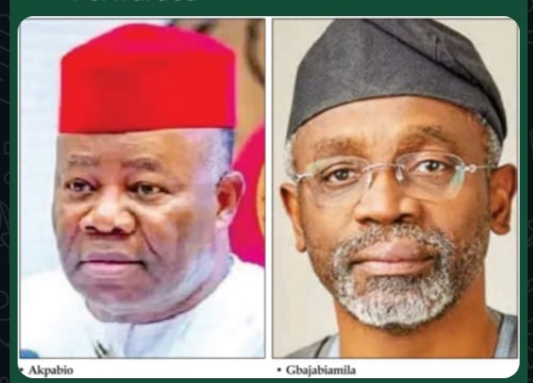
2027 NASS Race: Gbajabiamila, Akpabio Lead High-Stakes Talks as Kwara APC Faces Zoning Rift
Fresh details have emerged on how top figures within the All Progressives Congress (APC) are intensifying consultations to manage internal tensions ahead of the 2027 general elections, with Kwara State becoming a major focal point of the unfolding political chess game.
At the centre of the high-level engagements is the Chief of Staff to the President, Femi Gbajabiamila, who is leading the Presidential Supervision Team mandated to coordinate, monitor, and reduce friction in the National Assembly primaries. Gbajabiamila, alongside Presidential Adviser Ibrahim Masari, held strategic meetings with the leadership of the National Assembly to align interests between lawmakers and governors, particularly on the contentious issue of return tickets and succession ambitions.
In his role as Senate President, Godswill Akpabio actively participated in the discussions, representing the interests of Senators seeking re-election and those aspiring to transition into governorship positions. Akpabio, alongside Speaker Tajudeen Abbas and other principal officers, pushed for the retention of experienced lawmakers in the next assembly, warning against excessive turnover that could weaken legislative capacity. He also sought understanding from governors to accommodate lawmakers with strong electoral value, including defectors who recently joined the APC.
The meetings, held at the Presidential Villa and the Imo State Governor’s Lodge, were designed to harmonise positions and prevent a repeat of the internal crises that trailed the emergence of the 10th National Assembly. Gbajabiamila’s team emphasized the need for a balanced legislature combining experience with fresh entrants while also ensuring that governors, who have been empowered by President Bola Ahmed Tinubu to oversee nominations in their states, do not sideline key stakeholders.
However, the situation in Kwara has introduced a layer of complexity to the national negotiations. Governor Abdulrahman AbdulRazaq was notably absent from the Abuja meeting, reportedly due to disagreements over proposed candidate arrangements. Instead, he opted for a separate meeting with President Tinubu in Paris, a move interpreted as an effort to protect his political interests without committing to decisions made at the broader forum.
The core of the Kwara dispute lies in zoning and succession. AbdulRazaq is said to be pushing for the governorship ticket to be ceded to Kwara North Senatorial District, while also eyeing the Kwara Central senatorial seat for himself. However, influential forces within the Presidency and the APC hierarchy are backing Kwara Central for the governorship, citing its stronger voting base and strategic importance in countering opposition forces.
This calculation is largely influenced by the enduring political relevance of former Senate President Bukola Saraki, whose influence remains a major consideration in the party’s electoral strategy. To neutralize any potential resurgence, the APC is reportedly determined to field a strong candidate from Kwara Central.
Further strengthening this position is the rising profile of Senator Saliu Mustapha, whose political weight is seen as a critical asset. Other prominent aspirants from the district including Prof. Abubakar Olanrewaju Sulaiman, Dele Belgore, Dr. Ibrahim Yahaya Oloriegbe, and Dr. Abdulfatai Yahaya Seriki are also intensifying their consultations, setting the stage for a potentially fierce contest.
Insiders say Gbajabiamila’s ongoing mediation efforts are aimed at ensuring that such state-level disagreements do not escalate into broader party crises. Meanwhile, Akpabio and other National Assembly leaders continue to lobby for inclusiveness, warning that sidelining experienced lawmakers could undermine both governance and party unity.
As the APC moves closer to finalising its consensus arrangements, all eyes remain on President Tinubu, whose intervention is expected to determine the final outcome in contentious states like Kwara. If consensus proves impossible, party sources say the leadership may resort to transparent primaries—an option that could reshape the political equation in the state and beyond.
The Nation